How to Choose an NMN Supplement in 2026: 10 Things to Check Before You Buy
Buying an NMN supplement can look simple until you compare the labels.
One product may advertise 99%+ purity. Another may emphasize pharmaceutical-grade NMN. A third may highlight GMP manufacturing, third-party testing, or a much higher dose. Prices can vary significantly too.
The difficult part is knowing which claims actually matter and how to verify them.
A better approach is to evaluate every NMN supplement using the same checklist: dose, formula, purity, testing, COA, manufacturing, ingredients, packaging, price, and company transparency.
This guide explains what to check before buying, how to compare products objectively, and which marketing claims deserve a closer look.
How Do I Choose an NMN Supplement?
When choosing an NMN supplement, check how much NMN you receive per serving, what else is in the formula, whether purity is documented, whether testing is performed by an independent laboratory, whether a relevant COA is available, how the product is manufactured, what the complete ingredient label says, how it is packaged, what it costs per serving, and how transparent the seller is.
Do not choose a product simply because it has the highest dosage, lowest price, or strongest marketing language. Look for information you can actually verify.
Why Is Choosing an NMN Supplement So Difficult?
NMN has attracted growing scientific and consumer interest because it is a precursor involved in NAD+ biosynthesis. Human research has investigated NMN supplementation at different doses and durations, but the clinical evidence is still developing and does not establish that every marketed benefit of NMN supplements has been demonstrated in humans.
That makes product evaluation particularly important.
When shopping online, you may encounter claims such as:
- 99%+ pure
- Pharmaceutical-grade
- GMP manufactured
- Third-party tested
- High potency
- Pure NMN
- Premium NMN
- Clinically tested
The problem is that these phrases do not all answer the same question.
For example, purity concerns the composition of a tested material. GMP concerns manufacturing controls. Third-party testing concerns who performed an analysis. A COA provides documented analytical results.
Understanding those differences makes it easier to compare products without relying on marketing alone.
The 10-Point NMN Buying Checklist
Before buying an NMN supplement, evaluate these 10 factors:
- NMN dose per capsule and serving
- Formula and additional ingredients
- Purity documentation
- Independent third-party testing
- Certificate of Analysis
- Manufacturing standards
- Complete ingredient label
- Packaging and storage
- Price and actual value
- Seller and product transparency
Let's look at each one.
1. Check the NMN Dose Per Capsule
Start with the amount of NMN you are actually getting.
A bottle might contain 60 capsules, but that number alone tells you very little. You need to know the amount of NMN per capsule and the recommended serving size.
Check:
- NMN per capsule
- Capsules per serving
- Servings per bottle
- Total NMN per bottle
- Recommended daily serving
Why dose matters
Two products can have the same number of capsules but contain very different amounts of NMN.
For example:
| Product | Capsules | NMN per capsule | Total NMN |
|---|---|---|---|
| Product A | 60 | 250 mg | 15,000 mg |
| Product B | 60 | 500 mg | 30,000 mg |
Product B contains twice as much NMN per capsule, but that does not automatically make it the better choice.
Human NMN studies have used a range of doses. A systematic review of randomized trials found doses ranging from 250 to 2,000 mg per day across eight trials examining glucose and lipid outcomes, while other clinical studies have investigated different dose ranges.
The optimal NMN dose is not firmly established for everyone. One 2024 analysis specifically noted that the optimal dose remains unclear and found substantial individual variability in changes in blood NAD+ after supplementation.
Practical takeaway: Compare the dose, serving instructions, evidence, and product quality together instead of automatically choosing the highest number.
2. Check the Formula
Next, determine whether you are buying pure NMN or a combination formula.
Single-ingredient NMN
A single-ingredient formula makes it straightforward to identify the amount of NMN being provided.
Combination NMN
Some products combine NMN with other ingredients such as trans-resveratrol.
Neither approach should automatically be considered superior. The important question is whether you understand what each ingredient is doing in the formulation and how much of each ingredient you are receiving.
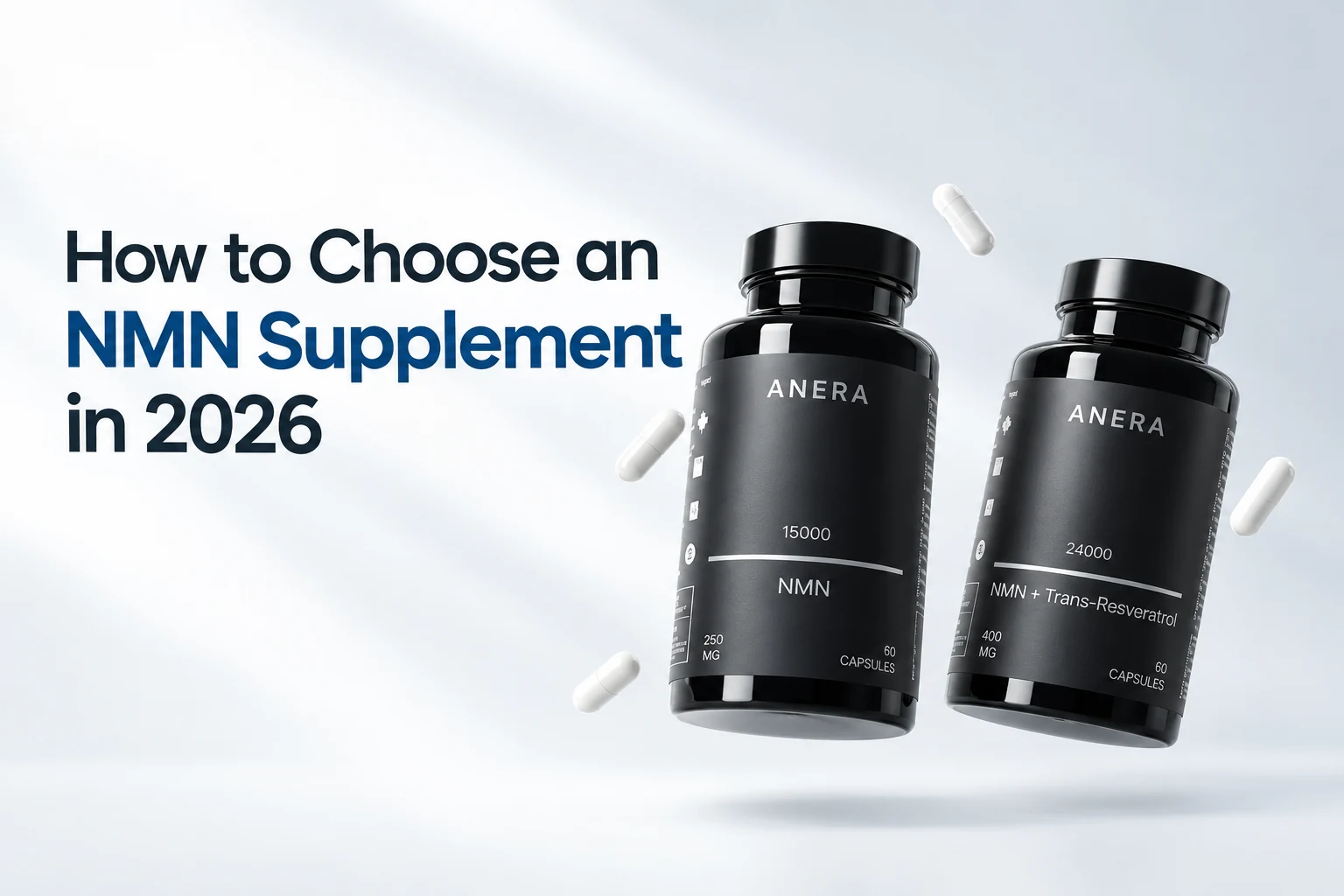
For example, a single-ingredient product such as NMN 15000 provides 250 mg of NMN per capsule.
A combination product such as NMN + Trans-Resveratrol 24000 provides:
- 250 mg NMN per capsule
- 150 mg trans-resveratrol per capsule
- 60 capsules
- 15,000 mg total NMN
- 9,000 mg total trans-resveratrol
This illustrates why the front label is not enough. You need to look at the complete formulation.
What to ask
Before buying a combination NMN product, ask:
What are the additional ingredients?
How much of each ingredient is provided?
Are the ingredients clearly disclosed?
Can I find testing information for the product?
3. Verify NMN Purity
Purity is one of the most frequently advertised NMN quality indicators, but it is also one of the easiest claims to misunderstand.
A statement such as "99% pure NMN" is a claim. What matters next is whether there is documentation showing how that result was determined.
Look for:
- Reported purity percentage
- Testing method
- Laboratory name
- Test date
- Product or batch identification
- Actual analytical result
What is HPLC testing?
HPLC, or high-performance liquid chromatography, is an analytical technique used to separate and analyze components in a sample.
If an NMN company provides an HPLC result, look beyond the phrase "HPLC tested."
Ask:
What was tested?
Which laboratory performed the analysis?
What method was used?
What was the actual result?
Which batch or sample does the result represent?
That is much more informative than a large purity number printed on a product page.
4. Look for Independent Third-Party Testing
Third-party testing means an external laboratory performs testing rather than the manufacturer relying exclusively on its own internal assessment.
This can provide additional transparency, particularly when the report identifies the tested product or batch.
When evaluating a third-party testing claim, look for:
- Laboratory name
- Product identification
- Batch or lot number
- Test date
- Analytical method
- Results
- Parameters tested
The NIH Office of Dietary Supplements notes that organizations such as USP, NSF, and ConsumerLab use different approaches to supplement quality testing. It also emphasizes that quality-testing seals do not, by themselves, guarantee that a product is safe or effective.
That is an important distinction.
Testing can provide evidence about a product's characteristics. It does not automatically prove every health claim made about the product.
5. Learn How to Read an NMN COA
A Certificate of Analysis (COA) can be one of the most useful documents when comparing NMN supplements.
But not every COA provides the same amount of useful information.
At minimum, look for these fields:
| COA Information | What It Tells You |
|---|---|
| Product name | What material was tested |
| Batch or lot | Which production batch was evaluated |
| Laboratory | Who performed the analysis |
| Test date | When the analysis occurred |
| Testing method | How the parameter was measured |
| Specification | Expected requirement or range |
| Actual result | What the laboratory found |
| Units | How the result is expressed |
Example
Suppose a report says:
NMN purity: 99.10%
That is more useful if you can also determine:
- Which product was tested
- Which batch was tested
- Which laboratory performed the test
- Which analytical method was used
- When the test occurred
This is why "COA available" and "COA that you can actually interpret" are not necessarily the same thing.
A dedicated COA guide can go much deeper into these fields, but these checks are enough to start comparing products responsibly.
6. Check Manufacturing Standards
Manufacturing standards are different from product testing.
One commonly referenced standard is Good Manufacturing Practice (GMP).
For dietary supplements in the United States, FDA regulations include specific current Good Manufacturing Practice requirements under 21 CFR Part 111. These requirements address areas such as production, process controls, quality control, facilities, equipment, and related manufacturing practices.
The exact regulatory framework varies between countries, so international buyers should consider the requirements applicable to their own market.
When a supplement company says its NMN is GMP manufactured, look for more information about:
- Manufacturing location
- Applicable manufacturing standards
- Quality-control procedures
- Manufacturer identity where appropriate
- Testing procedures
- Batch controls
- Product traceability
GMP does not mean "clinically proven"
This distinction is important.
GMP relates to how products are manufactured and controlled. It does not, by itself, establish that an NMN supplement produces a particular health outcome.
Think of manufacturing standards and product testing as different pieces of the quality picture.
7. Review the Complete Ingredient Label
Never make your decision based only on the front of the bottle.
Read the complete product label.
Check:
- NMN amount
- Serving size
- Other active ingredients
- Non-medicinal ingredients
- Capsule material
- Fillers or additives
- Allergens where applicable
- Directions
- Storage instructions
This is especially important when comparing a pure NMN product with a combination formula.
For example, a product may advertise NMN prominently on the front while containing several additional ingredients that you did not initially expect.
A transparent label makes comparison easier.
A useful rule
If you cannot clearly determine what you are consuming from the product information, you do not yet have enough information to compare it properly.
8. Check Packaging and Storage
Packaging is easy to overlook, but it can matter when evaluating a supplement.
Look for clear instructions concerning:
- Light exposure
- Heat
- Moisture
- Temperature
- Container closure
- Storage location
- Shelf-life information where provided
The manufacturer should tell you how the product is intended to be stored.
You can also examine whether the packaging appears designed to protect the contents from environmental exposure.
The important principle is not that one type of container automatically makes an NMN supplement superior. It is that packaging should have a clear practical purpose and appropriate storage instructions should be provided.
9. Compare Price Based on Actual Value
Price is important, but the bottle price alone can be misleading.
Instead, calculate:
Price per bottle
→ Price per serving
→ Cost per 100 mg of NMN
→ Approximate monthly cost
Example
Imagine two products:
Product A
- $100
- 60 capsules
- 250 mg NMN per capsule
Product B
- $80
- 30 capsules
- 500 mg NMN per capsule
Looking only at the bottle price makes Product B appear cheaper.
But the amount of NMN per bottle is:
- Product A: 15,000 mg
- Product B: 15,000 mg
Now the comparison becomes very different.
Both products provide the same total NMN, despite having different capsule counts and prices.
This is why cost per amount of NMN can be more informative than bottle price alone.
Of course, cost should still be considered alongside testing, formulation, manufacturing, packaging, and transparency.
10. Check the Seller and Product Transparency
Finally, investigate the company behind the product.
A transparent seller should make it possible to answer basic questions about what you are buying.
Look for:
- Identifiable company
- Contact information
- Complete product information
- Ingredient details
- Testing documentation
- Manufacturing information
- Storage instructions
- Clear purchasing and return policies
- Appropriate regulatory information for your market
- Realistic product claims
Be cautious with unsupported marketing
Claims such as:
- "World's best"
- "Guaranteed results"
- "Reverse aging"
- "Miracle supplement"
- "Number one"
- "Works for everyone"
do not tell you whether the product is pure, correctly manufactured, or properly tested.
The strongest buying decisions are usually based on specific, verifiable information rather than the strongest marketing language.
How to Compare Two NMN Supplements Side by Side
If you are comparing two products, use the same checklist for both.
| Factor | Product A | Product B |
|---|---|---|
| NMN per capsule | Check label | Check label |
| Serving size | Check label | Check label |
| Total NMN | Calculate | Calculate |
| Formula | Pure or combination | Pure or combination |
| Purity documentation | Verify | Verify |
| Testing laboratory | Identify | Identify |
| COA | Review | Review |
| Testing method | Identify | Identify |
| GMP information | Verify | Verify |
| Other ingredients | Review | Review |
| Packaging | Evaluate | Evaluate |
| Cost per serving | Calculate | Calculate |
| Cost per 100 mg | Calculate | Calculate |
| Company transparency | Evaluate | Evaluate |
This prevents one attractive feature from dominating the comparison.
A product with a higher dose may have weaker documentation. A product with a lower price may contain less NMN. A product with impressive packaging may provide limited testing information.
What Does "99%+ NMN Purity" Actually Mean?
A purity claim becomes more useful when it is supported by product-specific laboratory evidence.
The report identifies Enviro-Health Research Laboratories Inc. as the laboratory and gives September 2025 sample/test dates.
However, there is an important distinction:
A laboratory result applies to the sample or batch that was tested.
It should not automatically be interpreted as proof that every future production batch will have exactly the same result.
This is a useful principle when evaluating any supplement company.
When a brand presents a purity percentage, ask to see the evidence behind that number.
What About NMN Dosage?
Dosage deserves its own consideration because there is no universally established "best" NMN dose for every person.
Human trials have examined different amounts. For example, one randomized placebo-controlled study administered 250 mg/day for 12 weeks and reported an increase in blood NAD+ levels without obvious adverse effects in the study population.
Other trials have examined substantially different doses. A systematic review of randomized trials found studies using 250 to 2,000 mg/day for 14 days to 12 weeks, while another systematic review reported NMN doses ranging from 150 to 1,200 mg/day across included studies.
This does not mean that a particular study dose should automatically become a personal recommendation.
When evaluating an NMN product, consider:
- The amount per capsule
- The manufacturer's serving instructions
- The evidence available for the dose being discussed
- Your individual circumstances
- Whether professional advice is appropriate
If you take medication, have a medical condition, are pregnant or breastfeeding, or have another reason to be cautious about supplements, discuss NMN use with an appropriate healthcare professional.
Common Mistakes to Avoid
Mistake 1: Choosing the highest dose
Problem: More NMN does not automatically mean a better product or better outcome.
Better approach: Compare dose with the available evidence, product instructions, testing, and your circumstances.
Mistake 2: Choosing based on the lowest price
Problem: Bottle prices do not account for serving size or total NMN.
Better approach: Calculate cost per serving and cost per amount of NMN.
Mistake 3: Treating "99%+" as sufficient evidence
Problem: A number on a label is still a claim unless you can examine supporting documentation.
Better approach: Look for product-specific laboratory results.
Mistake 4: Assuming GMP means everything has been tested
Problem: GMP and laboratory testing address different aspects of quality.
Better approach: Evaluate manufacturing information and testing documentation separately.
Mistake 5: Looking only at the front label
Problem: Important ingredients and serving information may be elsewhere.
Better approach: Read the complete product label.
Mistake 6: Assuming a COA is automatically reliable
Problem: A document may not clearly identify the batch, laboratory, method, or result.
Better approach: Check every important field.
A Practical NMN Buying Checklist
Before placing an order, ask:
- Do I know how much NMN is in each capsule?
- Do I know the serving size?
- Is the formula pure NMN or a combination?
- Is there documented purity information?
- Is the product independently tested?
- Can I identify the testing laboratory?
- Can I review a relevant COA?
- Is the manufacturing information transparent?
- Have I checked the complete ingredient label?
- Is the packaging appropriate for the product?
- Have I calculated the cost per serving?
- Are the product claims realistic?
If you cannot answer several of these questions, consider researching the product further before purchasing.
Where Can You Find Reliable NMN Information?
For NMN itself, peer-reviewed research is more useful than relying solely on supplement marketing.
A good starting point is PubMed, where you can review published human studies and systematic reviews on NMN.
For example:
- A 2023 review examined the state of human NMN clinical research and highlighted that much of the broader NMN evidence still comes from preclinical research.
- A 2024 systematic review and meta-analysis evaluated randomized controlled trials of NMN and metabolic outcomes.
- A 2024 systematic review examined NMN and physical-performance outcomes across randomized controlled trials.
- A 2024 review discussed variability in NMN metabolism and clinical responses.
For manufacturing information, government sources such as the U.S. FDA provide explanations of dietary-supplement GMP requirements.
For general supplement-quality information, the NIH Office of Dietary Supplements explains different approaches to independent supplement testing and verification.
These sources do not tell you which commercial NMN product to buy. That is the point. They help you understand the evidence and quality concepts so you can evaluate products yourself.
Conclusion
Choosing an NMN supplement is less about finding the biggest dose or the lowest price and more about knowing what you are actually buying.
Before you order, check the NMN dose, formula, purity, third-party testing, COA, manufacturing standards, ingredients, packaging, cost, and company transparency. Most importantly, look for information that can be verified rather than relying on broad claims such as "premium," "pharmaceutical-grade," or "high potency."
A well-documented product gives you enough information to compare it fairly with other options. If important details such as testing results, batch information, ingredients, or manufacturing information are difficult to find, consider that a reason to investigate further.
Frequently Asked Questions
How do I know if an NMN supplement is high quality?
Look for transparent information about dose, formulation, purity, testing, manufacturing, ingredients, packaging, and the company selling the product. Product-specific laboratory documentation is particularly useful because it provides evidence you can examine rather than relying only on marketing claims.
What NMN purity should I look for?
A higher stated purity can be useful, but the percentage should be considered alongside the testing method and documentation. A purity number is more meaningful when you can identify the tested sample, laboratory, method, date, and actual result.
Does NMN need third-party testing?
Independent testing can provide additional evidence about a product's composition or other tested characteristics. When a company makes a third-party testing claim, look for the underlying laboratory information and determine what was actually tested.
What does third-party tested NMN mean?
It means an external laboratory performed testing on the material or product. The value of that testing depends on what was tested, the laboratory, the analytical method, the sample or batch, and the reported results.
Is pharmaceutical-grade NMN better?
The phrase should not be treated as a substitute for evidence. Evaluate what the manufacturer means by the term and then examine the product's purity documentation, testing, manufacturing information, ingredients, and labeling.
Should I buy pure NMN or a combination formula?
That depends on what formulation you want. A single-ingredient formula makes the NMN amount straightforward to evaluate, while a combination formula provides additional ingredients. In either case, check the amount of every active ingredient and review the complete label.
Is NMN powder better than capsules?
Neither format is automatically better. Capsules provide a pre-measured format, while powders may offer different serving and formulation characteristics. Compare NMN content, testing, ingredients, storage requirements, and convenience.
How can I compare NMN prices?
Compare the total NMN amount, price per serving, cost per 100 mg, and approximate monthly cost. Looking only at the bottle price can give you a misleading comparison.