Cheap NMN vs Quality NMN: What’s the Difference?
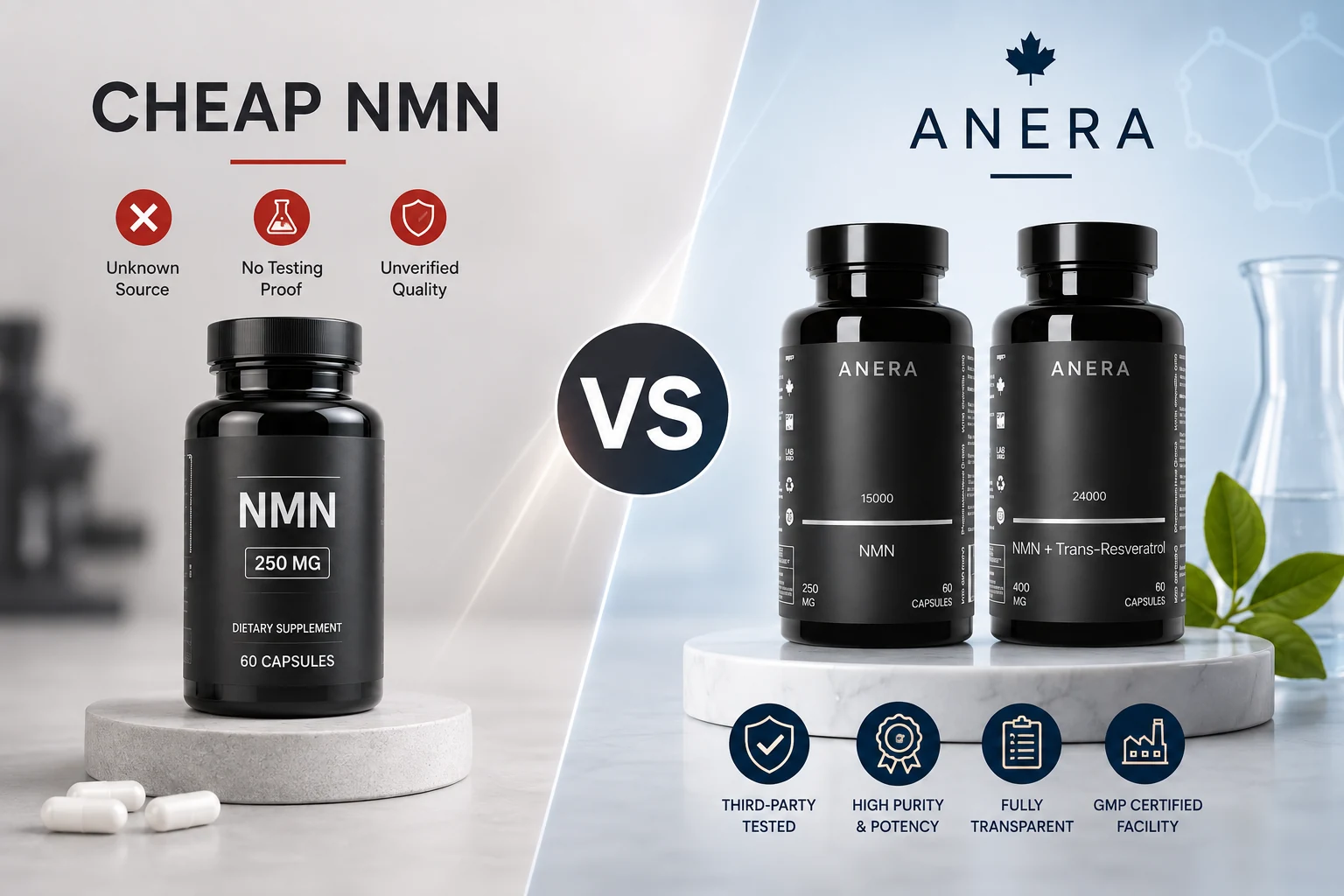
If you are comparing NMN supplements, you may notice a surprisingly wide difference in price. One product might cost considerably less than another while both appear to offer the same NMN ingredient and a similar dose.
Does that mean the cheaper NMN is lower quality?
Not necessarily. And a higher price does not automatically mean a better supplement.
The more useful comparison is what you receive for the price: verified ingredient identity, purity, potency, finished-product testing, manufacturing standards, documentation, formulation, transparency and cost per serving.
That distinction matters because two NMN supplements can list the same 250 mg dose while differing substantially in how the ingredient and finished product are tested, manufactured and documented.
This guide explains how to compare cheap NMN with higher-quality NMN so you can evaluate value rather than price alone.
Is Cheap NMN Automatically Low Quality?
No. A low-priced NMN supplement can represent good value if the manufacturer provides appropriate quality controls, accurate labeling and sufficient evidence that the product meets its specifications.
Likewise, an expensive NMN supplement is not automatically better.
The important question is:
Can the product's quality claims be verified, and does the additional cost provide meaningful value?
A useful NMN comparison should therefore go beyond the bottle price.
Look at:
- NMN identity
- Purity
- Potency
- Finished-product testing
- Certificate of Analysis (COA)
- Manufacturing standards
- Contaminant testing
- Ingredient sourcing
- Formulation
- Stability
- Transparency
- Cost per serving
If you're new to NMN, understanding the basics can make it easier to evaluate different products. Our guide to NMN for beginners explains what new users should know before choosing an NMN supplement.
For Canadian shoppers, regulatory status is another important consideration. Health Canada states that licensed natural health products carry an eight-digit Natural Product Number (NPN) or DIN-HM, and consumers can use Health Canada's database to check licensed products.
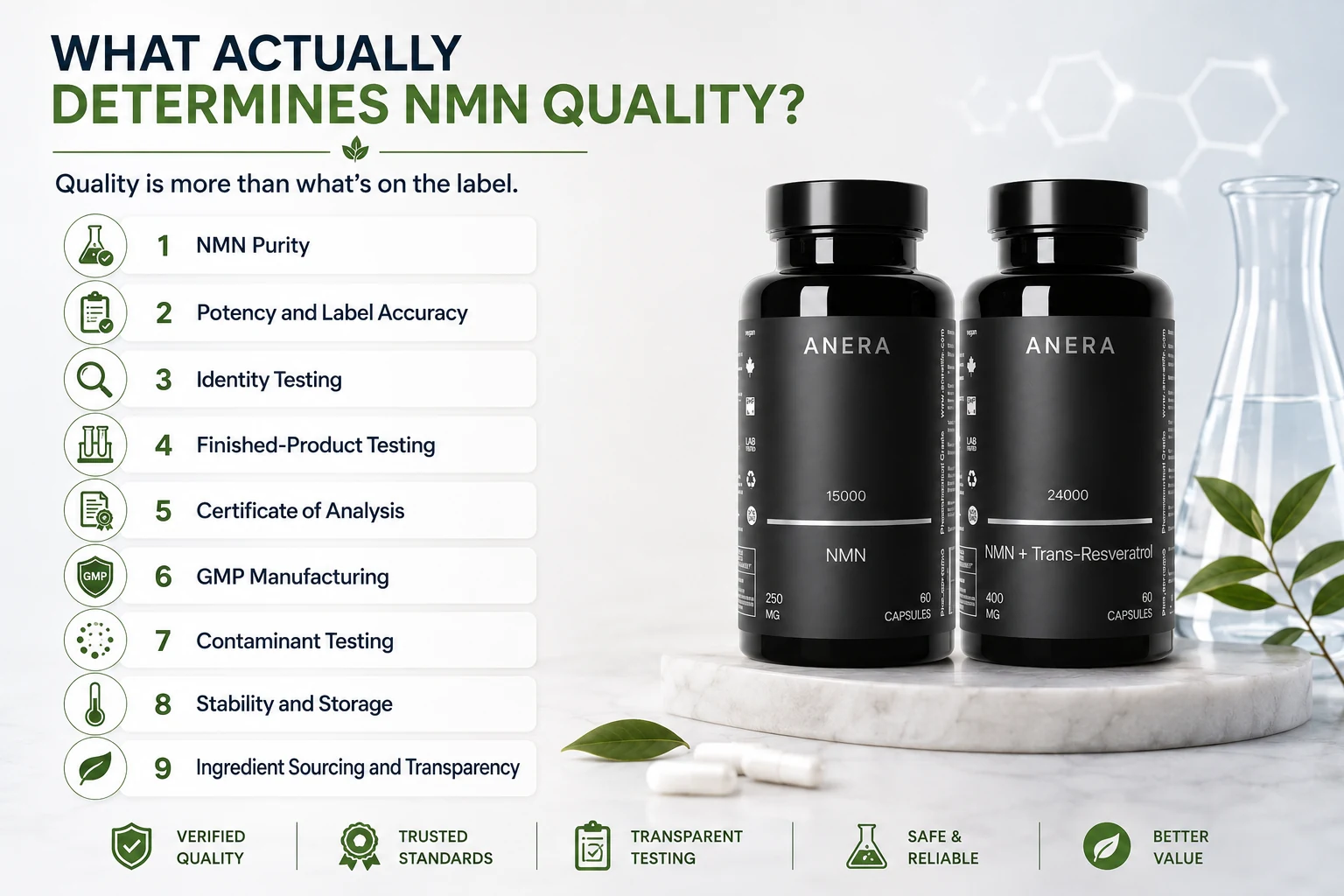
What Actually Determines NMN Quality?
Price is an outcome of many factors. Quality is determined by the controls behind the product.
1. NMN Purity
Purity describes how much of the tested material consists of the intended compound rather than unwanted substances or related impurities.
You may see products advertised as “99% pure NMN.” That number can be useful, but it should not be considered the entire quality story.
A raw NMN ingredient can have a high stated purity while the finished capsule still requires appropriate controls.
That is why shoppers should ask:
- What material was tested?
- What testing method was used?
- Was the raw ingredient tested?
- Was the finished product tested?
- Can the documentation be reviewed?
Purity is important, but purity alone does not prove finished-product quality.
2. Potency and Label Accuracy
Potency concerns whether the product contains the amount of active ingredient represented on the label.
For example, a product labelled as containing 250 mg of NMN per capsule should have specifications and testing controls designed to verify the stated quantity.
This is different from purity.
A simple way to remember the distinction is:
Purity asks: “How much of the material is the intended compound?”
Potency asks: “How much of the active ingredient is actually present in the product?”
Both can matter when evaluating an NMN supplement.
3. Identity Testing
Before worrying about how pure an ingredient is, you need to know that it is actually the intended ingredient.
Identity testing helps establish that the material being tested corresponds to the declared ingredient.
This is one reason a quality-focused supplement manufacturer needs more than a marketing statement on a product page.
4. Finished-Product Testing
This is an important distinction that is easy to miss.
Testing the raw NMN ingredient is not the same as testing the finished capsules.
During manufacturing, ingredients are combined, processed, encapsulated and packaged. Quality controls therefore need to address the final product as well.
Health Canada's current GMP guidance specifically describes finished-product testing as part of demonstrating that an NHP meets its specifications. It also discusses testing records, certificates of analysis and laboratory controls.
For shoppers, this means a statement such as “99% pure raw NMN” should not be treated as equivalent to comprehensive finished-product quality verification.
5. Certificate of Analysis
A Certificate of Analysis, commonly called a COA, is documentation showing analytical test results for a material or product.
A useful COA should provide enough information to connect the test results to the product or batch being evaluated.
Depending on the product and specifications, relevant information can include:
- Product or ingredient identity
- Batch or lot information
- Test results
- Testing methods
- Acceptance criteria
- Purity or potency results
- Relevant contaminant results
Health Canada's GMP guidance discusses certificates of analysis and requires appropriate quality systems around specifications and product release for regulated NHP activities. It also states that third-party laboratories should be appropriately qualified and that testing methods need to be suitable for the material or product.
For consumers, the key lesson is simple:
A COA is more useful when it is specific, traceable and connected to an actual batch, not merely presented as a generic quality badge.
6. GMP Manufacturing
GMP stands for Good Manufacturing Practices.
GMP is not simply another marketing phrase. It refers to manufacturing controls designed to ensure products are consistently produced and controlled according to established requirements.
Health Canada's current GMP guidance covers areas including manufacturing, packaging, labelling, importing, testing, quality assurance, specifications, records and product release.
Health Canada also explains that companies involved in manufacturing, packaging, labelling or importing NHPs for sale in Canada must meet applicable GMP requirements and hold the required licences.
For an NMN shopper, GMP is therefore useful as part of the quality picture, but it should not replace looking at the product's actual specifications and testing information.
7. Contaminant Testing
Quality evaluation can extend beyond the declared active ingredient.
Depending on the product and its risk profile, manufacturers may need to control or test for relevant contaminants.
Potential areas of interest can include:
- Heavy metals
- Microbial contamination
- Other chemical contaminants
- Endotoxins where relevant
The exact testing program should be appropriate for the product and its specifications.
This is another reason not to reduce NMN quality to one purity percentage.
8. Stability and Storage
NMN quality also depends on maintaining the product's characteristics through its shelf life.
Manufacturers should consider factors such as:
- Ingredient stability
- Formulation
- Packaging
- Moisture exposure
- Temperature
- Storage conditions
- Shelf-life controls
A supplement can begin with a high-quality ingredient, but maintaining quality requires appropriate manufacturing and storage controls.
9. Ingredient Sourcing and Transparency
Where does the NMN come from?
How is the ingredient identified?
What information does the manufacturer provide about its specifications?
A transparent brand should make it easier for shoppers to understand what they are purchasing rather than relying exclusively on vague terms such as “premium,” “advanced,” or “ultra-pure.”
Understanding how NMN relates to NAD+ can also help when evaluating NMN supplements. Our guide to NMN vs NAD+ explains the difference between these two compounds and how they are connected.
Why Can Two NMN Products With the Same Dose Cost Different Amounts?
Imagine two NMN products:
| Feature | Product A | Product B |
|---|---|---|
| NMN per capsule | 250 mg | 250 mg |
| Capsule count | 60 | 60 |
| Stated purity | Similar | Similar |
| Finished-product testing | Unclear | Documented |
| COA availability | Unclear | Available |
| Manufacturing information | Limited | Detailed |
| Formula | Single ingredient | Single or multi-ingredient |
| Transparency | Limited | Higher |
| Price | Lower | Higher |
At first glance, both products appear identical.
But the label only tells you part of the story.
The higher-priced product may have additional costs associated with:
- More extensive testing
- Quality assurance
- Manufacturing controls
- Batch documentation
- Higher-quality raw materials
- More complex formulations
- Packaging
- Canadian manufacturing
- Regulatory compliance
- Research and development
- Supply-chain controls
That does not mean every expensive product is worth more.
It means the buyer should determine whether the additional price corresponds to meaningful differences.
Cheap NMN vs Quality NMN: What Should You Compare?
| Quality Factor | What to Check | Why It Matters |
|---|---|---|
| NMN identity | Is the ingredient properly identified? | Confirms what the material is |
| Purity | Is there analytical evidence? | Helps assess ingredient quality |
| Potency | Does testing support the labelled amount? | Helps verify dose accuracy |
| Finished-product testing | Is the final product tested? | Raw material testing is not enough by itself |
| COA | Is batch-specific documentation available? | Improves transparency |
| GMP | Are appropriate manufacturing controls in place? | Supports consistency and quality assurance |
| Contaminant testing | Are relevant contaminants addressed? | Helps identify quality risks |
| Formulation | What else is included? | Determines what you are actually buying |
| Stability | Are storage and shelf-life controls addressed? | Supports product quality over time |
| Transparency | Can claims be independently understood or verified? | Reduces purchase uncertainty |
| Cost per serving | What does each serving cost? | Makes price comparisons more meaningful |
The table shows why “cheapest NMN” is not always the same thing as “best value NMN.”
How to Compare NMN Value Instead of Price
One of the easiest mistakes is comparing bottles rather than servings.
Suppose:
- Product A costs $60 and contains 30 servings.
- Product B costs $100 and contains 60 servings.
Product B has a higher bottle price, but its cost per serving is lower.
The basic calculation is:
Cost per serving = Product price ÷ Number of servings
You can take the comparison one step further:
Cost per 100 mg of NMN = Cost per serving ÷ NMN per serving × 100
However, even this calculation has limitations.
A cheaper cost per 100 mg does not automatically mean better value if the products differ in testing, formulation, documentation or other quality characteristics.
For a more detailed breakdown of NMN supplement cost, including price per capsule, cost per day, monthly cost, dosage, capsule count, formulation, and quality considerations, see our guide to comparing NMN prices and value.
A more useful comparison therefore looks like:
Price → Dose → Servings → Testing → Manufacturing → Transparency → Overall value
The overall value of an NMN supplement can also depend on how easily it fits into your daily routine.
If you're comparing products and want to learn more about when NMN is typically taken, see our guide to the best time to take NMN for a research-informed look at morning, afternoon, and evening timing.
What Should You Look for When Buying NMN in Canada?
Canadian shoppers have another useful quality checkpoint: regulatory status.
Health Canada says NHPs licensed for sale in Canada carry an eight-digit NPN or DIN-HM. The NPN indicates that Health Canada has authorized the product for sale under the applicable framework.
When evaluating an NMN supplement in Canada, consider checking:
1. NPN or applicable regulatory information
Look for the relevant product licence information and verify it where appropriate.
2. Manufacturing standards
Determine where the product is manufactured and what GMP information is provided.
3. Testing documentation
Look for meaningful evidence rather than simply a “third-party tested” badge.
4. COA information
If a COA is provided, check whether it identifies the product, lot or batch and includes meaningful analytical results.
5. Label transparency
Make sure the ingredient amounts, serving size and formulation are clearly stated.
6. Quality claims
Be cautious when marketing terms are presented without supporting documentation.
Health Canada's current guidance is particularly relevant here because its GMP framework addresses specifications, testing, laboratory controls, quality assurance and product release.
Anera Life's Approach to NMN Quality
Anera Life provides a useful example of how a quality-focused NMN brand can position its products.
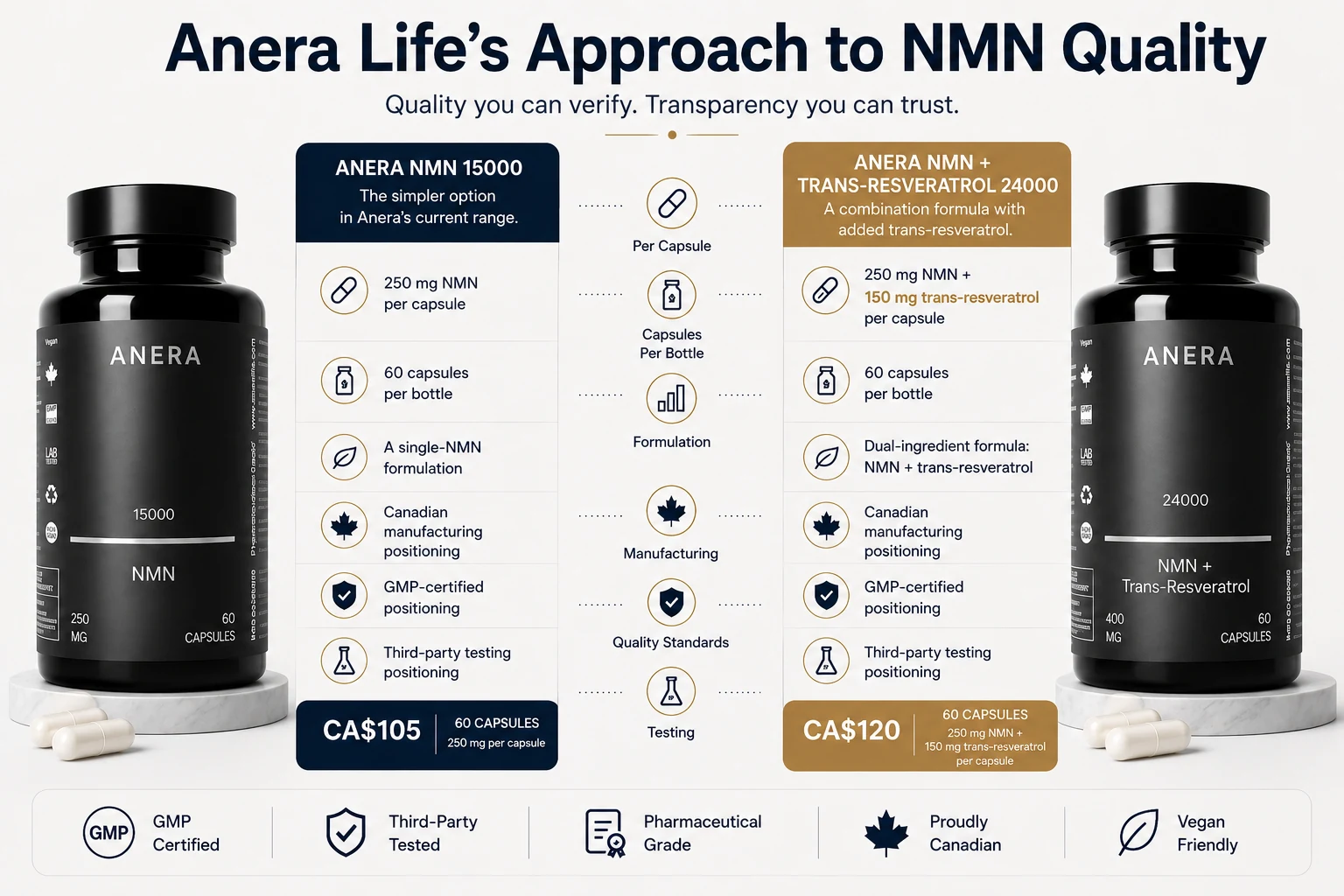
Its current product information lists NMN 15000 as a 250 mg NMN-per-capsule formula with 60 capsules. The product page currently lists CA$105 and identifies GMP certification, third-party testing, pharmaceutical-grade positioning and Canadian manufacturing.
Anera NMN 15000
NMN 15000 is the simpler option in Anera's current range.
It provides:
- 250 mg NMN per capsule
- 60 capsules
- A single-NMN formulation
- Canadian manufacturing positioning
- GMP-certified positioning
- Third-party testing positioning
This type of formula may appeal to someone who wants to evaluate NMN without adding another active ingredient.
The important point is not that the product is automatically “better” because it costs more.
Instead, shoppers can evaluate it against the same criteria used for every other NMN product: dose, formulation, testing, manufacturing, documentation and value.
Anera NMN + Trans-Resveratrol 24000
Anera's NMN + Trans-Resveratrol 24000 combines 250 mg NMN with 150 mg trans-resveratrol per capsule and contains 60 capsules. The current Anera product listing shows a price of CA$120.
The difference here is formulation rather than simply NMN quantity.
Someone comparing it with a single-ingredient NMN product should therefore ask:
- Do I want only NMN?
- Do I want a combination formula?
- Does the additional ingredient fit my supplement routine?
- Am I comparing equivalent formulas?
- Does the additional cost make sense for what I actually want?
That is a better buying decision than assuming a larger price automatically means better quality.
Common Mistakes When Buying Cheap NMN
Mistake 1: Choosing the cheapest bottle
The lowest bottle price tells you almost nothing about cost per serving or quality.
Better approach: Calculate cost per serving and then compare the supporting quality information.
Mistake 2: Looking only at the purity percentage
“99% pure” sounds impressive, but purity is only one part of product quality.
Better approach: Ask whether identity, potency and finished-product testing are also addressed.
Mistake 3: Confusing raw-material testing with finished-product testing
A supplier's raw NMN COA does not automatically tell you everything about the final capsule.
Better approach: Distinguish ingredient-level documentation from finished-product quality controls.
Mistake 4: Assuming expensive means better
A high price can reflect genuine quality investments or simply positioning and marketing.
Better approach: Identify what additional value the price represents.
Mistake 5: Comparing different formulations as if they were identical
A pure NMN capsule and an NMN-plus-resveratrol formula are not exactly the same product.
Better approach: Compare like with like first, then decide whether a combination formula better matches your needs.
Mistake 6: Ignoring transparency
A product can have an attractive label while providing little information about manufacturing or testing.
Better approach: Give more weight to specific, verifiable information than vague quality language.
Is Premium NMN Worth the Extra Cost?
Sometimes, but only when the additional price is supported by meaningful quality or formulation differences.
Premium pricing can make sense when it reflects things such as:
- Stronger quality-control systems
- More comprehensive testing
- Better documentation
- Transparent batch information
- Appropriate manufacturing standards
- Higher-quality formulation
- Greater transparency
- A combination of ingredients that genuinely matches your preferences
But there is no rule that the most expensive NMN is the best choice.
Likewise, there is no rule that a cheap NMN supplement is poor quality.
The best purchase is the one where you can understand what you are paying for.
Does NMN Research Prove That a More Expensive Product Works Better?
No. Research on NMN is primarily about NMN itself and the outcomes studied under particular experimental conditions, not about whether one commercial brand is superior to another because it costs more.
Human research has investigated oral NMN supplementation, including studies involving 250 mg/day for 12 weeks and higher doses in other trials. A randomized trial reported increased whole-blood NAD+ levels following 250 mg/day NMN, while recent reviews continue to note that larger and longer studies are needed to establish broader clinical benefits and long-term safety.
That distinction matters.
Evidence that NMN can affect a biological marker does not prove that a particular premium brand will produce better health outcomes than a cheaper brand.
For that reason, this article focuses on product quality and purchasing decisions rather than making medical or anti-aging promises.
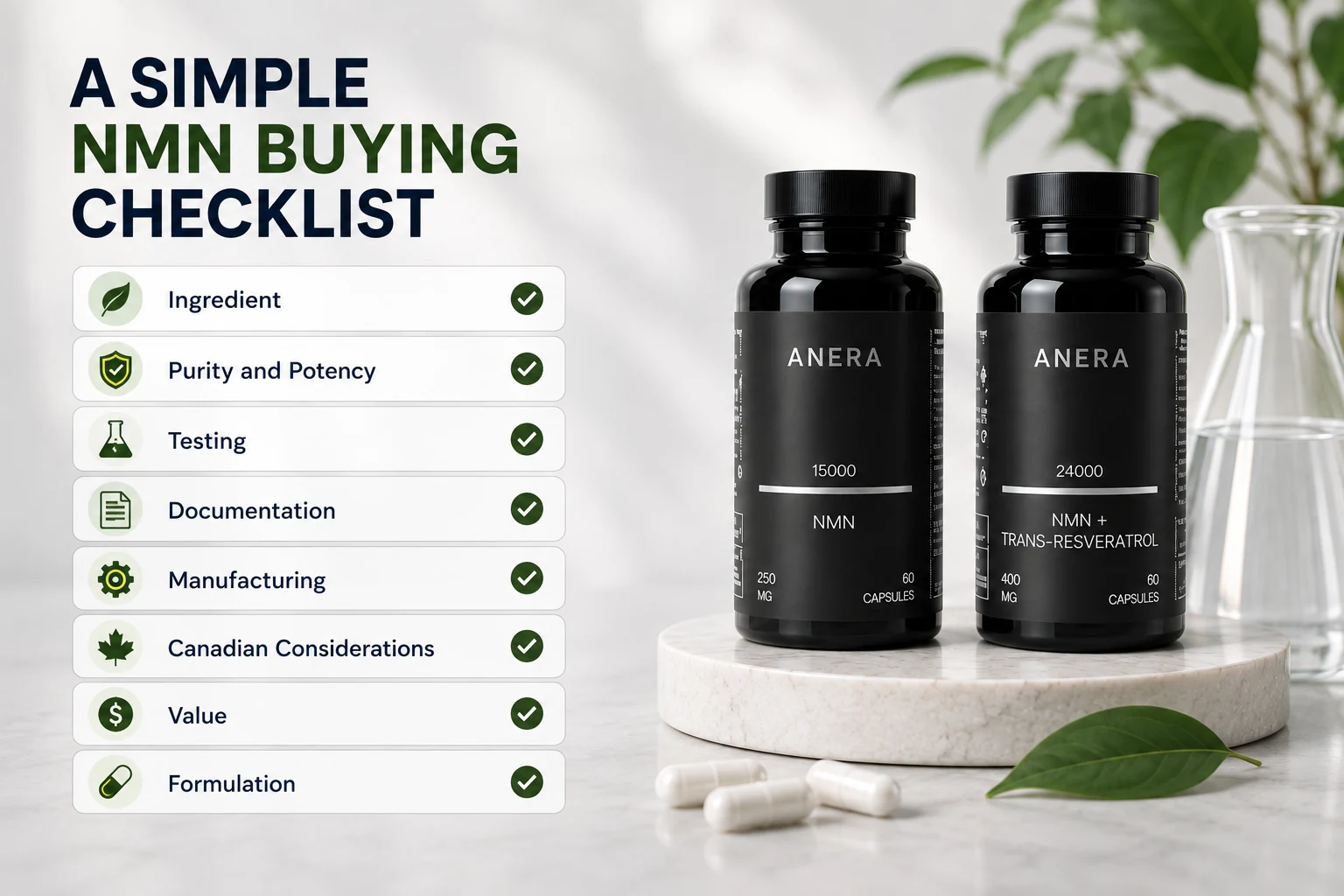
A Simple NMN Buying Checklist
Before buying an NMN supplement, ask:
Ingredient
- Is the ingredient clearly identified?
- Is the amount per serving stated?
Purity and potency
- Is there analytical evidence?
- Are purity and potency being distinguished?
Testing
- Is the finished product tested?
- Are relevant contaminants addressed?
- Is third-party testing clearly explained?
Documentation
- Is a COA available?
- Does it relate to a specific product or batch?
Manufacturing
- Where is the product manufactured?
- What GMP information is available?
Canadian considerations
- Does the product have the appropriate Canadian licensing information?
- Can the NPN be verified where applicable?
Value
- What is the cost per serving?
- How much NMN do you receive per serving?
- Are you paying for meaningful quality features or simply branding?
Formulation
- Is it pure NMN?
- Does it contain additional ingredients?
- Do those ingredients fit your goals and preferences?
If you can answer these questions, you are in a much better position to distinguish cheap NMN from genuinely good value.
Final Takeaway
The difference between cheap NMN and quality NMN is not simply the price printed on the bottle.
Cheap does not automatically mean low quality, and premium does not automatically mean better.
The smarter comparison is:
Purity + Potency + Identity + Testing + COA + Manufacturing + Formulation + Transparency + Cost per Serving = Better NMN Value Assessment
For Canadian shoppers, regulatory information and manufacturing controls add another layer to the evaluation.
If you are comparing products, start with the quality checklist above and then compare products based on what you can actually verify.
For shoppers who prefer a simple NMN formula, Anera's NMN 15000 provides 250 mg of NMN per capsule. Those looking for a combination formula can compare it with NMN + Trans-Resveratrol 24000, which combines 250 mg NMN with 150 mg trans-resveratrol per capsule.
The goal is not to buy the cheapest NMN or the most expensive NMN.
It is to buy the product whose quality, formulation and price make the most sense for you.
Frequently Asked Questions
Is cheap NMN safe?
Price alone cannot determine whether an NMN product is safe or unsafe. Evaluate the product's regulatory status, manufacturing controls, specifications, testing, labeling and documentation rather than using price as a safety proxy.
Is expensive NMN better?
Not automatically. A higher price is meaningful only when it reflects verifiable differences such as testing, manufacturing controls, documentation, formulation or other quality attributes that matter to the buyer.
What makes a quality NMN supplement?
A quality NMN supplement should have clear ingredient identity and dosage information, appropriate specifications, suitable manufacturing controls, relevant testing and transparent documentation. No single purity number proves overall product quality.
What is an NMN COA?
A Certificate of Analysis is analytical documentation showing test results for an ingredient or product. A useful COA should provide enough information to connect the results to the relevant material or batch and show whether specifications were met.
Is 99% pure NMN enough?
No. A high purity figure can be useful, but it does not by itself establish finished-product quality. Identity, potency, manufacturing controls, contaminant testing and finished-product testing should also be considered.
Does third-party testing matter for NMN?
It can provide additional assurance when the laboratory, testing method and results are appropriately documented. Health Canada's GMP guidance specifically discusses third-party laboratory testing and the need for suitable laboratories and valid testing methods.
Does GMP mean an NMN product is better?
GMP indicates that manufacturing is subject to defined quality requirements and controls. It is an important quality factor, but shoppers should still evaluate the specific product's formulation, specifications, testing and documentation.
How should I compare NMN prices in Canada?
Start with cost per serving rather than bottle price. Then compare the NMN amount per serving, formulation, testing, manufacturing standards, documentation and regulatory information. This provides a much more useful measure of value.
Is NMN worth paying more for?
That depends on what the additional price provides. If a higher-priced product offers quality controls and transparency that matter to you, the additional cost may be justified. Price alone is not enough to make that decision.
Choose NMN Based on Quality, Not Just Price
A lower price doesn't automatically mean poor quality, and a premium price doesn't automatically guarantee a better supplement. The best NMN is the one backed by transparent manufacturing, verified testing, clear formulation details, and evidence you can evaluate for yourself.
If you're looking for high-quality NMN supplements in Canada, explore Anera Life's collection of pharmaceutical-grade NMN formulas designed with transparency and quality standards in mind.
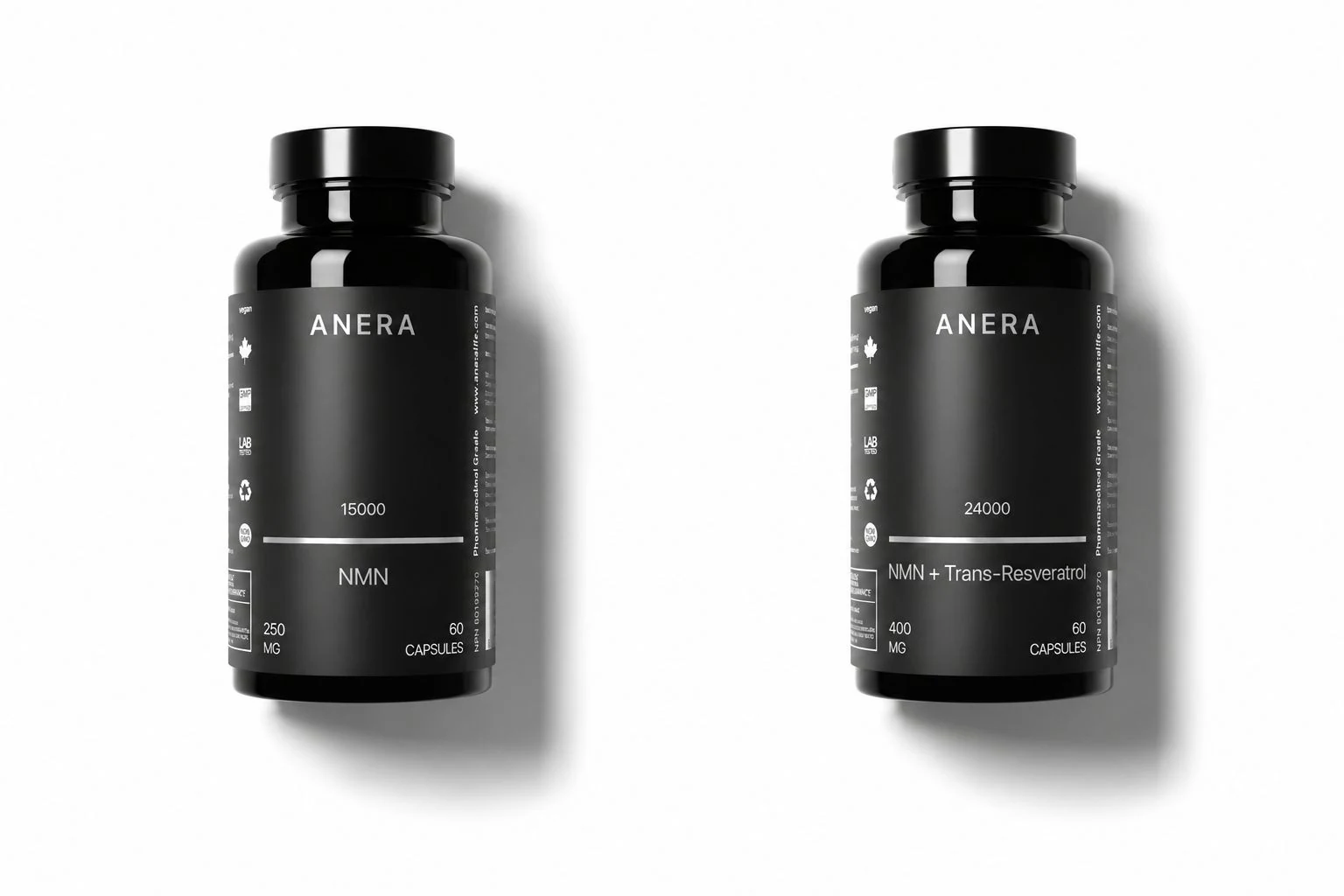
Whether you prefer a simple 250 mg NMN capsule or a formula that combines NMN with trans-resveratrol, you can compare the ingredients, dosage, and product details before deciding which option fits your wellness routine.