Timing & Dosage · NMN Guide

Best Time to Take NMN for Maximum Results: Morning or Night?

August 24, 2026 · 16 min read
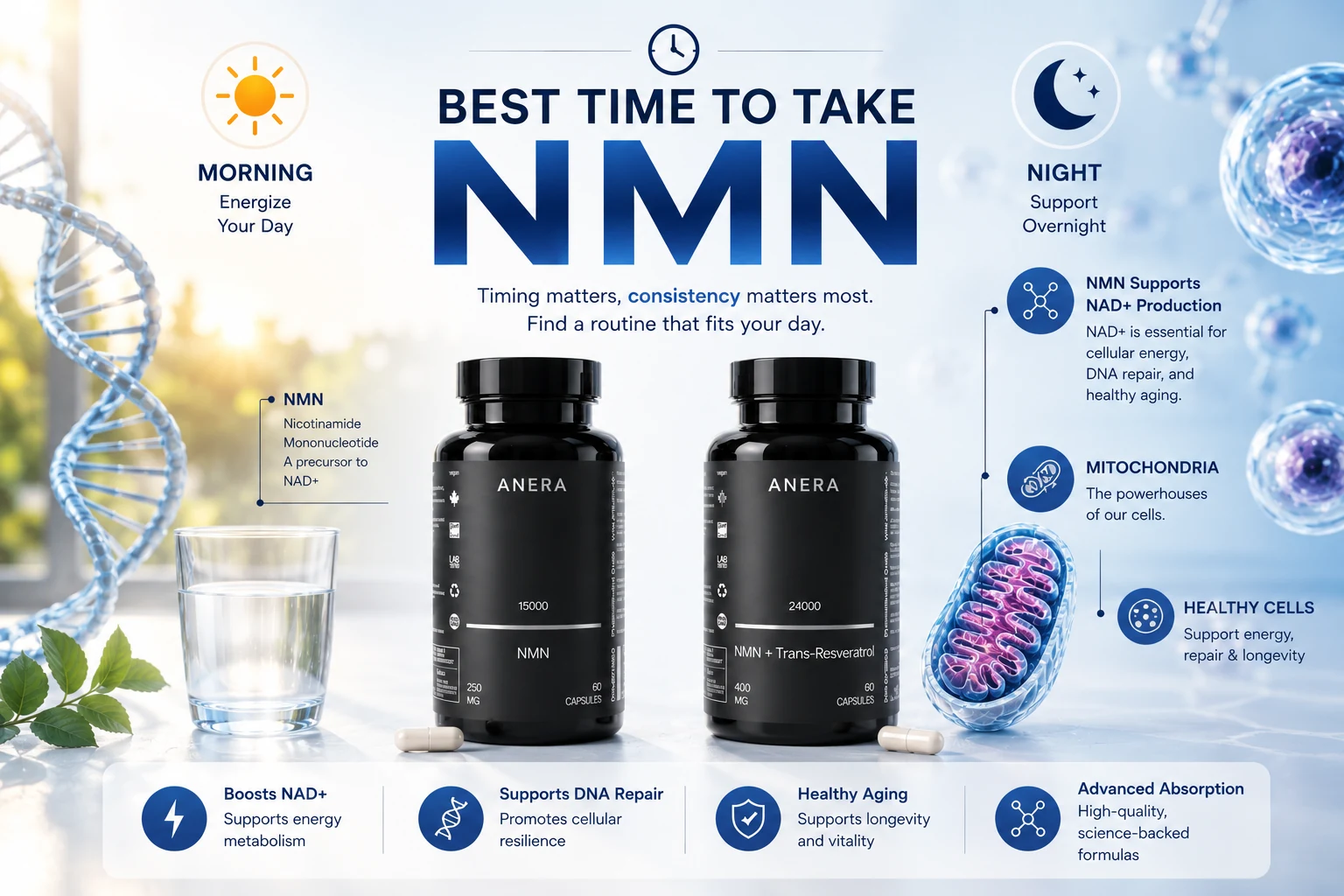
Best Time to Take NMN

If you're wondering about the best time to take NMN, morning is a practical default for many people, but current human research does not establish that morning is universally better than evening. The most important factors are following the product directions and choosing a schedule you can maintain consistently.

NMN, or nicotinamide mononucleotide, is a precursor involved in the body's production of NAD+, a coenzyme used in numerous cellular processes. Human studies have shown that oral NMN can increase NAD+-related biomarkers, although evidence for broader health and performance outcomes remains mixed.

Timing is an interesting part of NMN research because NAD+ metabolism is connected with biological rhythms. Researchers have therefore investigated whether taking NMN earlier or later in the day may influence outcomes differently.

What Is the Best Time to Take NMN?

Morning Is a Practical Default

For people looking for a simple answer, morning is a practical time to take NMN. It can be easy to connect NMN with an established habit such as waking up, eating breakfast, or starting the workday.

Morning administration has also been used in human NMN research. One study involving healthy volunteers provided 250 mg of NMN once each morning for 12 weeks and found increased plasma NMN and NAD+ concentrations.

Another human study administered NMN in the morning after participants woke up and compared those results with afternoon administration. The study specifically investigated whether timing influenced sleep quality, fatigue, and physical performance.

However, these studies should not be interpreted as proof that everyone will achieve better results by taking NMN in the morning. Research designs, participants, outcomes, and dosing protocols vary.

For that reason, morning should be viewed as a practical default not a clinically proven optimal time.

Is Morning Scientifically Proven to Be Better?

No, not definitively. The relationship between NAD+ metabolism and circadian biology provides a scientific reason to investigate timing, but a biological rationale is not the same as proof of a superior supplementation schedule.

A randomized, double-blind, placebo-controlled study specifically examined 250 mg of NMN taken either in the morning or in the evening for 12 weeks in older adults. The researchers assessed sleep, fatigue, and physical performance rather than simply assuming that one dosing period was automatically better.

This distinction matters when evaluating NMN information online. Claims such as “NMN must be taken before 9 AM for maximum results” go beyond what current human evidence can establish.

Best time to take NMN: Morning is a reasonable default because it is easy to incorporate into a daily routine and has been used in human research. However, current evidence has not established one universally superior time of day.

Why Does NMN Timing Matter?

Why Does NMN Timing Matter

NMN timing is worth discussing because NMN participates in the biological pathway associated with NAD+ production.

NMN and NAD+ Production

NMN is a precursor in NAD+ metabolism. NAD+ is involved in energy metabolism, cellular signaling, DNA repair, and the activity of NAD+-dependent enzymes. This is one reason researchers are studying NMN as a way to influence NAD+-related biology.

The simplified pathway can be viewed as:

NMN → NAD+ → NAD+-dependent cellular processes

Human research has demonstrated that oral NMN can increase NAD+-related biomarkers, including blood or cellular NAD+ measures. A 2026 systematic review concluded that oral NMN and related NAD+ precursors reliably demonstrate biochemical target engagement in humans, while broader clinical outcomes remain heterogeneous.

That distinction is important: increasing a biomarker does not automatically mean that a supplement will produce a particular health outcome.

NAD+ and the Circadian Rhythm

NAD+ metabolism is connected with circadian biology, which helps explain why researchers are interested in whether the time of supplementation matters.

The body's biological clock influences numerous metabolic processes throughout the day. This creates a plausible scientific basis for studying morning versus evening NMN intake.

But again, plausibility is not proof. A mechanism can explain why a question deserves research without establishing a specific recommendation for consumers.

What Does Human Research Actually Show?

The most useful evidence comes from controlled human studies that directly compare different dosing times.

In one randomized, double-blind study, participants received 250 mg of NMN either in the morning or from approximately 6 PM until bedtime for 12 weeks. The researchers evaluated sleep quality, fatigue, and physical performance. Some outcomes differed between groups, but the findings did not establish a universal rule that morning NMN is always superior to evening NMN.

This is why the most evidence-based answer is also the simplest: choose a consistent time that fits your routine, with morning serving as a practical starting point.

NMN in the Morning vs. at Night

The question of morning vs. night is one of the most common NMN timing questions. The available evidence does not support an absolute rule that NMN only works in the morning or that taking it at night makes it ineffective.

Instead, the best timing depends on the research available, product directions, and what fits consistently into your daily routine.

TimingPotential Practical AdvantageResearch Consideration
MorningEasy to pair with breakfast or a morning routineUsed in human research
AfternoonUseful for people who miss their morning routineLess established
EveningConvenient for some schedulesEvening dosing has been studied
Before bedEasy to attach to a nighttime habitNo established need to take NMN specifically at bedtime

Taking NMN in the Morning

Morning is often the easiest option because it creates a simple habit.

For example, you could associate NMN with brushing your teeth, preparing breakfast, or starting work. A consistent routine can reduce the likelihood of accidentally skipping a dose.

Morning administration has also been investigated in human studies. In one study, healthy volunteers consumed 250 mg of NMN once daily in the morning for 12 weeks. Researchers observed increases in plasma NMN and NAD+ concentrations.

However, this does not demonstrate that morning NMN produces better long-term health outcomes than evening NMN.

It also does not mean that taking NMN immediately after waking is necessary. There is no established evidence showing that a specific morning minute or hour maximizes results.

Taking NMN in the Afternoon

Afternoon dosing can be a reasonable alternative for someone whose mornings are busy or inconsistent.

If you regularly forget supplements before breakfast but reliably remember them after lunch, an afternoon routine may be more sustainable.

There is also human research specifically investigating NMN administered later in the day. In one study, the afternoon/evening schedule began after 6 PM and continued until bedtime.

That research is useful because it demonstrates that evening administration is not simply an untested idea.

Still, the evidence remains too limited to recommend afternoon dosing as universally superior.

Taking NMN at Night

Current research suggests that nighttime or evening administration should not automatically be considered ineffective.

The randomized timing study mentioned above included an NMN group taking 250 mg during the post-meridian period, defined as approximately 6 PM until bedtime. Researchers assessed multiple outcomes, including sleep quality, fatigue, and physical performance.

Therefore, saying “NMN should never be taken at night” would be too strong.

At the same time, there is no compelling evidence that taking NMN immediately before bed is necessary or that bedtime dosing produces superior results.

For most people, the better approach is to choose a timing window that is easy to maintain and consistent with the product's instructions.

What If NMN Affects Your Sleep?

Sleep is an especially important consideration because individual responses can vary.

Rather than assuming that NMN universally improves or disrupts sleep, look at what human research actually measures. The 12-week timing study evaluated sleep-related outcomes but did not establish a simple rule that everyone should take NMN at night or avoid it at night.

If you personally notice that taking NMN later in the day interferes with your sleep, moving it earlier may be a reasonable practical adjustment.

This is different from claiming that NMN causes insomnia. Individual experiences should not be turned into universal conclusions.

Should You Take NMN With Food or on an Empty Stomach?

Should You Take NMN With Food or on an Empty Stomach

Another common question is whether NMN should be taken before breakfast, with food, or between meals.

The current evidence does not establish a universal requirement that NMN must be taken on an empty stomach.

NMN Before Breakfast

Some human research has specifically used morning administration. One study provided 250 mg of NMN once each morning and observed increases in plasma NMN and NAD+.

This supports the idea that morning, including before breakfast depending on the study protocol, is a reasonable research-based timing option.

NMN With Breakfast

Taking NMN alongside breakfast may be useful simply because it connects supplementation with an established daily habit.

For many people, adherence matters more practically than trying to optimize a precise minute of the day.

Does Food Affect NMN Absorption?

There is not enough evidence to confidently claim that taking NMN on an empty stomach always produces superior absorption.

Avoid unsupported statements such as “empty stomach gives maximum absorption” or “fat dramatically increases NMN absorption.”

Instead, follow the manufacturer's directions and choose a routine you can maintain consistently.

For Anera Life customers, the product label and serving instructions should remain the primary reference for how the specific formulation is intended to be used.

How Much NMN Should You Take?

Timing is only one part of an NMN routine. Dose matters too, and more is not automatically better.

Human studies have investigated different NMN doses, with 250 mg per day appearing in several controlled trials. For example, randomized studies have examined 250 mg/day in older adults and reported increases in NAD+-related biomarkers, although the effects on physical or other health outcomes have varied between studies.

Common NMN Doses Studied in Human Research

A number of human NMN trials have used approximately 250 mg per day, while other research has examined higher amounts.

However, research doses should not automatically be interpreted as personalized recommendations. Study participants may have different ages, health characteristics, diets, exercise habits, and study conditions.

The 2026 systematic review of NAD+-related supplementation found that oral NMN consistently demonstrated biochemical target engagement in humans, but effects on metabolic, vascular, physical-performance, and other health outcomes were mixed.

Does More NMN Mean Better Results?

Not necessarily. Increasing the amount does not guarantee proportionally greater benefits. Higher-dose research can tell scientists more about dose-response relationships, but it does not mean that every person should take a larger amount.

Instead of increasing your dose because you do not notice an immediate difference, consider whether you are following the product's directions consistently and giving the routine enough time to evaluate.

Follow the Product Label

When using an NMN supplement, start with the manufacturer's serving instructions.

Anera Life's product information should be used as the reference for the intended serving size, formulation, and usage instructions. If you have questions about whether NMN is appropriate for you particularly if you take medications or have an existing medical condition, speak with a qualified healthcare professional.

How to Build a Consistent NMN Routine

The best NMN routine is often the one you can actually follow.

How to Build a Consistent NMN Routine

Instead of focusing on whether 7:00 AM is better than 9:00 AM, create a repeatable habit that fits naturally into your day.

Option 1 — Morning Routine

Wake up → NMN → breakfast

This is a straightforward option for people who prefer taking supplements early in the day.

You could keep the product in a location that reminds you of your morning routine, while following the product's storage and usage instructions.

Option 2 — Breakfast Routine

Breakfast → NMN → daily routine

If you regularly eat breakfast, connecting NMN with that meal can make supplementation easier to remember.

This approach may be particularly useful if you prefer not to think about supplements immediately after waking.

Option 3 — Afternoon Routine

If mornings are unpredictable, an afternoon routine can provide a practical alternative.

The goal is not to find an arbitrary “perfect” time. The goal is to create a schedule that is realistic and repeatable.

The Most Important Rule: Consistency

Consistency is one of the most useful principles for building a supplement routine.

Human NMN research generally evaluates supplementation over weeks rather than expecting meaningful outcomes from a single dose. For example, controlled trials have investigated daily NMN supplementation over periods such as 8 or 12 weeks.

That does not mean everyone will experience the same results after a particular number of weeks. It simply shows why judging NMN based on one or two doses can be misleading.

Best Time to Take NMN Based on Your Goal

NMN for Daily Energy Support

If your goal is to build NMN into a daytime wellness routine, morning can be a practical starting point.

However, avoid treating NMN as an instant energy product. NMN research primarily focuses on its role as an NAD+ precursor, and human evidence for broader effects remains under investigation.

NMN for Healthy Aging Research

NMN is widely studied in the context of NAD+ biology and aging research.

For consumers, however, it is important to distinguish between promising biological research and established clinical outcomes. Current evidence supports biological activity but does not establish NMN as a proven anti-aging treatment.

NMN and Sleep

If sleep is an important consideration, timing may deserve individual attention.

A randomized trial directly investigated morning and evening NMN intake and included sleep-related outcomes. The findings do not justify a blanket recommendation that NMN must be taken at night or that it should always be avoided at night.

NMN and Exercise

Some human studies have investigated NMN alongside exercise, including research involving recreationally trained runners. However, this does not prove that taking NMN immediately before a workout is the optimal strategy for everyone.

If exercise is part of your routine, consistency and following the product directions are more defensible priorities than trying to identify a precise pre-workout minute.

NMN and NAD+ Support

NMN's central scientific interest comes from its role in NAD+ metabolism.

Human research has repeatedly investigated whether oral NMN can increase NAD+-related biomarkers, and recent reviews support evidence of biochemical target engagement. However, increases in biomarkers should not be presented as guaranteed improvements in healthspan or performance.

Common NMN Timing Mistakes to Avoid

A good NMN routine does not require complicated timing rules. Avoid these common mistakes:

1. Taking NMN at a different time every day. A changing schedule can make it easier to forget.

2. Assuming nighttime NMN is automatically ineffective. Evening administration has been investigated in human research.

3. Assuming morning NMN is scientifically proven to be superior. Current evidence does not establish a universally optimal time.

4. Increasing the dose because results are not immediate. More NMN does not automatically mean better outcomes.

5. Expecting instant effects. Human research generally evaluates NMN over weeks, not after a single serving.

6. Ignoring product-specific instructions. Different formulations may have different serving recommendations.

7. Treating animal research as equivalent to human evidence. Human outcomes remain more limited and mixed than many promotional claims suggest.

How Long Does NMN Take to Work?

How long does NMN take to work?” is more complicated than it may seem because biomarker changes and noticeable health effects are not the same thing.

Human research has demonstrated that NMN can increase NAD+-related biomarkers. For example, controlled studies using daily NMN supplementation have reported increases in blood NAD+ or related metabolites after periods of supplementation.

However, a change in a biomarker does not automatically translate into a noticeable improvement in energy, exercise performance, sleep, or healthy aging.

The 2026 systematic review of NAD+-related supplementation found that oral NMN and related compounds reliably demonstrated biochemical target engagement in humans, while findings for metabolic, vascular, performance, and other health outcomes were heterogeneous.

For this reason, it is better to think of NMN as a supplement being investigated for its effects on NAD+ biology rather than promising a specific timeline for noticeable results.

Best Time to Take NMN — Quick Answer

QuestionShort Answer
Best time to take NMN?Morning is a practical default.
Can you take NMN at night?Yes. Evening dosing has been studied.
With food or without?Follow product directions; consistency is important.
Should you take NMN every day?Follow the product's recommended use.
Is morning proven superior?No definitive human evidence establishes this.
Does timing matter more than consistency?A consistent routine is a practical priority.

A Simple NMN Timing Strategy

A Simple NMN Timing Strategy

For most people, there is no need to make NMN timing complicated.

Start with a morning routine if that fits naturally into your day. Take it consistently according to the product's instructions. If morning does not work for your schedule, another consistent time may be more practical.

The evidence does not support chasing a specific “perfect hour.” What matters more is making an informed choice, following the recommended serving instructions, and understanding the difference between promising NMN research and proven clinical outcomes.

Frequently Asked Questions About NMN Timing

What is the best time to take NMN?

Morning is a practical default because it is easy to connect with a daily routine. Human research has also used morning NMN administration. However, current evidence has not established one universally optimal time of day, so consistency remains important.

Should I take NMN in the morning or at night?

Morning is a reasonable starting point, but evening NMN is not automatically ineffective. A randomized human study specifically investigated morning and evening administration. Because evidence remains limited, choose the timing that fits your routine and product directions.

Can I take NMN on an empty stomach?

Some human studies have administered NMN in the morning before breakfast, but current evidence does not establish that taking NMN on an empty stomach is universally superior. Follow product instructions and maintain a consistent routine.

How long does NMN take to work?

There is no universally established timeline for noticeable effects. Human studies have shown changes in NAD+-related biomarkers over weeks of supplementation, but broader outcomes such as energy, performance, and healthy aging remain less certain.

Can I take NMN every day?

Daily NMN supplementation has been used in multiple human research studies lasting several weeks or months. However, research protocols are not personal recommendations. Follow the serving instructions for your Anera Life product and consult a healthcare professional when appropriate.

Can I take NMN with other supplements?

NMN may be included in a broader supplement routine, but compatibility depends on specific products, doses, medications, and individual circumstances. Review product labels and consult a qualified healthcare professional about potential interactions when necessary.

Make NMN Part of Your Daily Routine

Looking to add NMN to your daily wellness routine? Explore Anera Life NMN supplements, formulated with quality and transparency in mind. Choose the NMN formula that fits your routine and supplement goals.

Anera Life NMN supplements

Explore Anera Life NMN Supplements